A theme park on a swamp, with no roads and no train station
Tokyo Disneyland opened on April 15, 1983 — on reclaimed marshland along Tokyo Bay, in a location that had almost nothing going for it. The nearest train station was seven kilometers away, tucked inside a quiet residential neighborhood. The expressway ran right past the site, but you had to overshoot the exit and make a U-turn to get in. There was no purpose-built road. No direct rail link. And of course, no GPS.
Despite all of that, the park was expected to draw 10 million visitors a year. On busy days, 80,000 people would show up at once — more per square meter than Walt Disney World in Florida. Getting that many people to and from a poorly connected site on Tokyo Bay, without gridlocking the surrounding neighborhoods, was a problem nobody had fully solved before.
Thirteen years earlier, Expo '70 in Osaka had collapsed under the weight of its own crowds. Japan's planners remembered. So before a single shovel hit the ground at Maihama, the Chiba Prefectural Police and Oriental Land Co. sat down to design a traffic system from scratch. What they came up with still runs today — almost entirely unchanged. And it all flows through one number: 8,000.
Opening a mega-park where the main road didn't exist yet
In 1983, the highway that would eventually run along Tokyo Bay was still under construction. The park opened anyway — served only by the capillaries of the road network: narrow local streets threading through residential neighborhoods. Tens of thousands of cars, funneled through roads designed for daily commutes and grocery runs.
This wasn't just inconvenient. It was a genuine threat to the people who lived there. The Chiba Prefectural Police recognized that without a plan, Disneyland's success could quietly destroy the quality of life for everyone nearby. So they wrote three founding principles before any infrastructure was designed — hard constraints that shaped every road decision, every gate, every bus stop.
-
Keep Disneyland traffic off the arteries
Once the main coastal highway opened, it would carry the load. Until then — and always — Disney traffic must not bleed into the broader network and stall it.
-
Protect the capillaries — the residential streets
The neighborhoods nearest the park were already carrying the traffic. Families living there must not have their streets turned into overflow parking lots or shortcut routes for lost tourists.
-
Make the routes in and out safe by design
Not by signage alone. Not by hoping guests behave. Safe by the structure of the roads themselves.
Eight Engineering Decisions Made Before Opening Day
With annual attendance projected at 10 million (peak days: 80,000 visitors), and 60% of guests expected to arrive by car, the design team worked backwards from a critical question: how many cars can we process per hour?
That calculation locked in 8,000 spaces and 10 booths — simultaneously. The parking lot footprint was then actually enlarged during design to hit that target. One number determined the other.
-
Traffic routed onto the arterial, away from residential streets
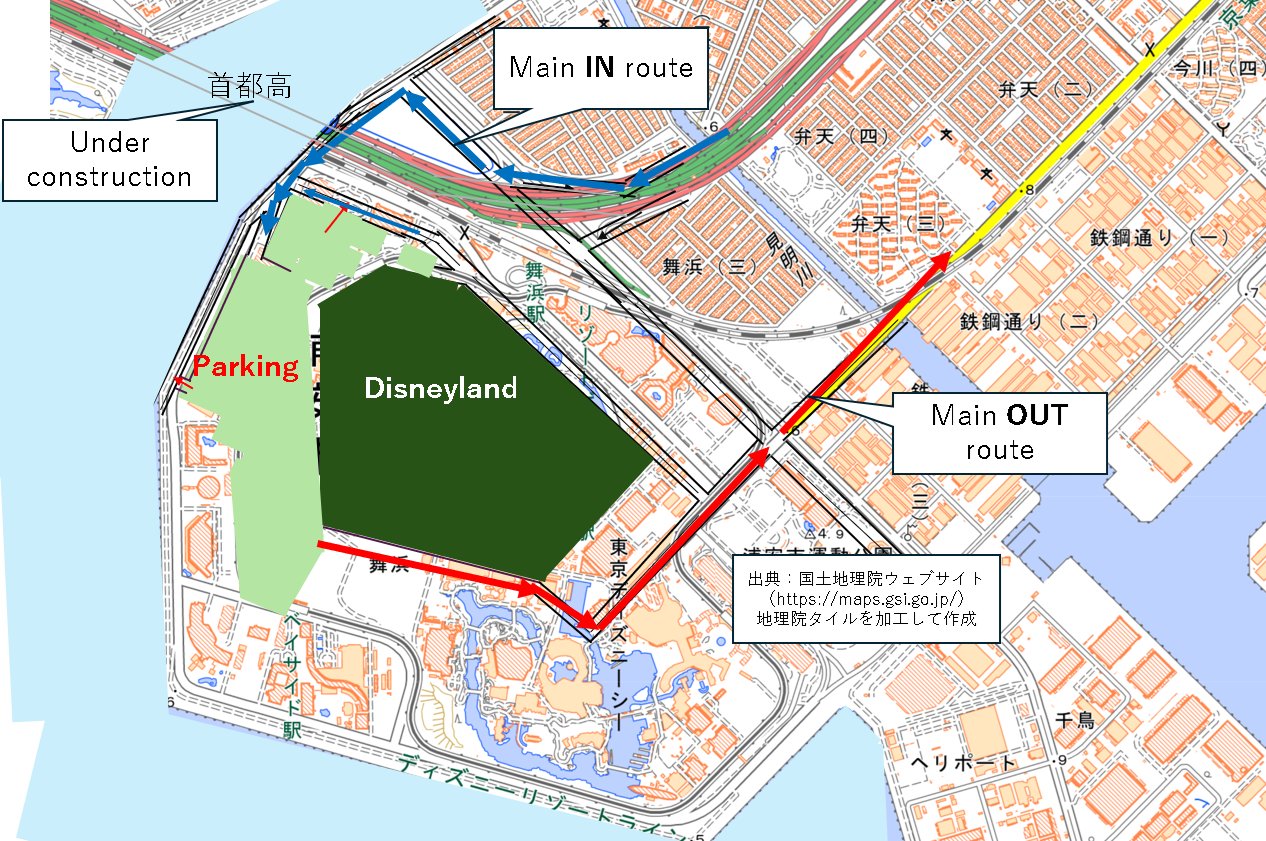
Cars were directed onto the coastal highway service road — the one artery wide enough to absorb the volume — keeping them structurally away from the capillaries of the surrounding neighborhoods.
-
38 directional signage boards
In the pre-GPS era, tourists from across Japan needed to be guided in. Thirty-eight custom signs were installed before opening day — it still wasn't enough (see Chapter 3).
-
Five distinct parking zones
General vehicles · Buses · Motorcycles · Drop-off only · Disabled access. Separating "drop-off" and "disabled" as independent zones was unusual for the era and remains rare today.
-
Left-turn-in, left-turn-out design
One entry point. Three exits. No right turns — anywhere. Cars never wait in a turning queue, and entry and exit flows never cross each other, even on public roads. This design principle is now called "left-in, left-out" in traffic engineering — Tokyo Disneyland was an early real-world implementation.
-
Shuttle buses routed away from homes
The nearest station shuttle ran every 1–2 minutes at peak, deliberately taking the long way around to avoid residential side streets. Its stop was physically separated from regular city bus stops so Disney queues wouldn't back up into local transit.
-
Road modifications locked in before opening day
Four one-way sections. Twenty-five new crosswalks. Two no-lane-change zones. The physical shape of the roads was changed — not just the rules on them.
-
Prefecture-wide traffic monitoring
Multiple regional traffic control centers coordinated in real time. Eight thousand cars arriving at once is roughly equivalent to a small town picking up and moving — and someone had to watch the whole region, not just the parking lot.
"The Queue Reached the Expressway." Four Things Nobody Predicted.
The plans were meticulous. The plans were also wrong — in ways that revealed just how extraordinary the demand was.
Guests stayed 7 hours. The plan assumed 2–3.5.
Designers expected the parking lot to cycle through cars 2–3 times a day as guests came and went. Instead, people arrived and stayed for the whole day. The lot filled and didn't empty. Overflow queues stretched back onto the expressway. Over five years, temporary lots were added to reach 20,000 total spaces — then 25,000 cars showed up anyway, triggering park-entry limits.
38 signs weren't enough. Six more were added immediately.
Visitors from all over Japan — many seeing expressway exits for the first time — got lost in numbers nobody had predicted. The need to add signs after opening is a quiet testament to how far people traveled.
Rush-hour conditions until 10:30 a.m.
On weekends, over 30,000 people funneled through a suburban station in a residential neighborhood. The ticket windows posted notices reading: "Today's same-day tickets are sold out. Entry not possible." Commuter-level crowds appeared on the platform every morning.
Operations suspended at 8:30 a.m.
The Tokyo Station direct bus became so overwhelmed on opening days that it had to stop running before 9 a.m. The solution: launch routes from Ueno, Narita, Haneda, Yokohama, and eventually Osaka, Kanazawa, and beyond — turning the bus network into a national one.
The Keiyo Line opened. Rail overtook cars overnight.
When the JR Keiyo Line finally connected Maihama Station directly to Tokyo Station, rail ridership jumped to 43% of all visitors — surpassing private cars for the first time. The Urayasu shuttle bus was dramatically reduced. The same line also linked Makuhari Messe, Chiba Marine Stadium, and Kasai Rinkai Park, turning the entire Tokyo Bay coast into one connected leisure corridor.
Why Disneyland Built a Second Park — Instead of a Bigger Parking Lot
Whenever the lot overflowed, the obvious question arose: why not just add more spaces? The answer is simpler than it sounds — and more permanent.
More parking means more cars. More cars means the entry gates get overwhelmed. Overwhelmed gates back up into the roads outside. And once the roads outside back up, you've broken the very system you spent years designing. Expanding the parking lot doesn't just mean pouring more concrete. It means starting over.
So instead of expanding inward, the resort expanded outward. Tokyo DisneySea got its own parking. Each new hotel got its own lot. The shopping complex got its own spaces. The resort grew — as a distributed network of separate nodes, each with its own capacity, none of them overwhelming any single road.
8,000 isn't a cap. It's a keystone. Pull it, and the arch falls.
The Secret Isn't Getting People In. It's Getting Them Not to Leave All at Once.
Traffic jams happen when everyone moves at the same time. The real magic of Tokyo Disney Resort isn't the entry system — it's the invisible architecture of departure that has been built around the park over four decades.
None of it is coercive. Guests choose everything freely. But every choice is a choice to leave later.
-
Souvenir shops open after park closing time
"Let's grab one more thing before we go" — fifteen more minutes in the lot means fifteen fewer cars on the road at peak.
-
Ikspiari shopping complex
A full mall attached to the resort. Dinner, drinks, retail therapy — every hour a guest spends here is an hour of outbound traffic deferred.
-
Disney Resort Line (monorail)
The loop monorail circulates between parks and hotels. Tired guests take it instead of fighting for their cars immediately. Each ride is a small, joyful act of traffic dispersion.
-
15,471 hotel rooms within shuttle distance
At two guests per room, roughly 30,000 people — around 40% of a typical day's visitors — can simply not leave. They sleep. They eat breakfast. They drive home Tuesday morning, when the roads are empty.
Traffic engineers call the result "demand dispersion." Disney calls it hospitality. The roads call it relief.
The Magic Was Never Inside the Park
Every Disney visitor knows about the FastPass, the parades, the fireworks. Very few know that before the first guest ever walked through the gates in 1983, a team of traffic engineers, police planners, and resort designers spent years solving a problem that most theme parks just accept as unavoidable: the chaos of 75,000 people trying to go home at the same time.
The answer they arrived at wasn't a single clever trick. It was a philosophy — and it still runs the resort today. Build the infrastructure so that dispersal is natural. Make staying easier than leaving. Never overload a single node. Design for the neighbors, not just the guests.
When you're sitting in the parking lot after closing time, edging slowly toward the exit while thinking about what an inefficient mess it is — you're actually inside one of the most finely tuned traffic systems ever designed for a theme park. The jam you're experiencing is the system working. It's absorbing you, slowing you down just enough that the roads outside remain clear.
The 8,000-space lot hasn't changed because it cannot change — not without rebuilding everything around it. It is, in the truest sense, the keystone of a 40-year arch.